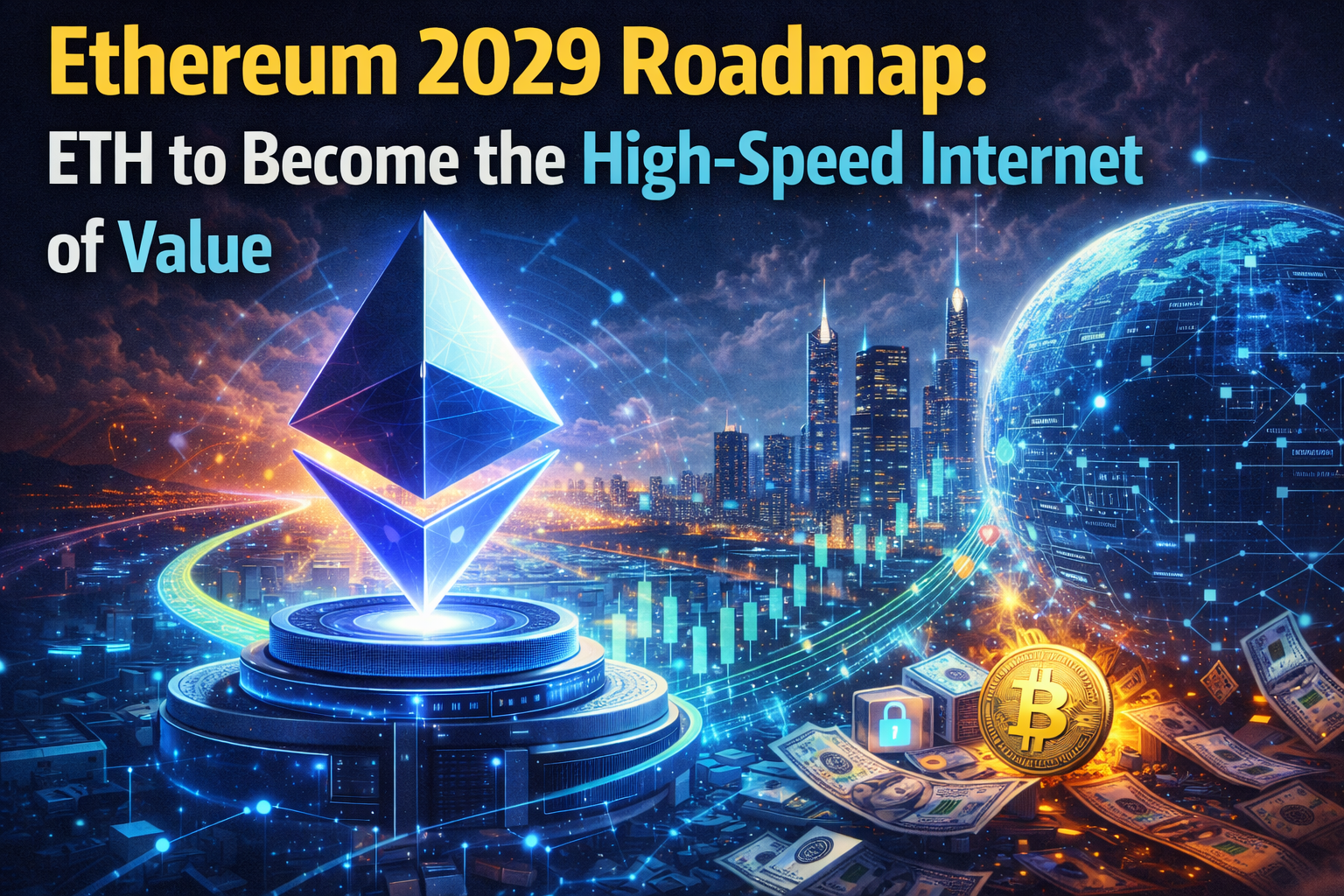
The future of blockchain is evolving rapidly, and Ethereum is positioning itself at the center of this transformation. With its long-term roadmap extending toward 2029, Ethereum aims to become what many experts are calling the “high-speed internet of value” a global infrastructure capable of handling fast, secure, and scalable financial transactions.
But what does this vision really mean, and how close is Ethereum to achieving it?
What is the “Internet of Value”?
The term “internet of value” refers to a system where money, assets, and financial data can move instantly across the globe just like information does on the internet today.
Ethereum’s goal is to:
- Enable instant transactions worldwide
- Reduce costs to near zero
- Support billions of users
- Power decentralized applications (dApps) at scale
In simple terms, Ethereum wants to do for finance what the internet did for communication.
Ethereum’s Roadmap to 2029
Ethereum’s long-term strategy is built around continuous upgrades that improve scalability, efficiency, and usability. The roadmap is often broken into multiple phases:
1. The Surge (Scalability Focus)
This phase focuses on increasing transaction throughput using technologies like rollups and data sharding.
- Thousands of transactions per second (TPS)
- Lower gas fees
- Better user experience
Layer-2 solutions such as rollups will handle most transactions, reducing congestion on the main network.
2. The Verge (Efficiency Improvements)
The Verge introduces advanced cryptographic techniques to make running Ethereum nodes easier.
- Reduced hardware requirements
- Increased decentralization
- Faster verification processes
This ensures that more people can participate in securing the network.
3. The Purge (Simplification)
Ethereum aims to reduce complexity by removing unnecessary data and technical debt.
- Smaller blockchain size
- Easier maintenance
- Improved performance
This step is crucial for long-term sustainability.
4. The Splurge (Final Enhancements)
The final phase includes various upgrades that improve usability and functionality.
- Better user interfaces
- Enhanced smart contract capabilities
- More efficient transaction processing
Why This Matters
Ethereum’s roadmap is not just about technical upgrades it’s about redefining global finance.
If successful, Ethereum could:
- Replace traditional payment systems
- Power decentralized finance (DeFi)
- Enable tokenization of real-world assets
- Support global digital economies
This would position Ethereum as a foundational layer for the future financial system.
Role of Layer-2 Solutions
A key part of Ethereum’s vision involves Layer-2 scaling solutions.
Instead of processing every transaction on the main chain, Layer-2 networks handle transactions off-chain and then settle them on Ethereum.
Benefits include:
- Faster speeds
- Lower fees
- Reduced congestion
This approach allows Ethereum to scale without compromising security.
Challenges Ahead
Despite its ambitious roadmap, Ethereum still faces several challenges:
1. Competition
Other blockchains are also aiming to become scalable and efficient.
2. Complexity
Implementing multiple upgrades over time is technically challenging.
3. Adoption Barriers
Mass adoption requires user-friendly interfaces and real-world use cases.
4. Regulatory Uncertainty
Global regulations around crypto could impact growth.
What Happens by 2029?
By 2029, Ethereum aims to achieve:
- Near-instant transactions
- Extremely low fees
- Massive scalability
- Global adoption
If these goals are met, Ethereum could function as the backbone of a decentralized financial system truly becoming the “internet of value.”
What Should Investors Watch?
If you’re following Ethereum’s progress, keep an eye on:
- Layer-2 adoption growth
- Network upgrades and timelines
- Developer activity
- Institutional involvement
These factors will determine how successfully Ethereum executes its vision.
FAQs
1. What is Ethereum’s 2029 roadmap?
It’s a long-term plan to improve scalability, efficiency, and usability, aiming to make Ethereum a global financial infrastructure.
2. What does “internet of value” mean?
It refers to a system where money and assets can be transferred instantly and globally, similar to how data moves on the internet.
3. What are Layer-2 solutions?
They are secondary networks that process transactions faster and cheaper while relying on Ethereum for security.
4. Can Ethereum handle billions of users?
That’s the goal. With upgrades and Layer-2 scaling, Ethereum aims to support massive global adoption.
5. What are the biggest risks?
Competition, technical challenges, and regulatory uncertainty.
6. Is Ethereum a good long-term investment?
Many believe so due to its strong ecosystem, but like all crypto assets, it carries risk.
Conclusion
Ethereum’s 2029 roadmap presents a bold vision transforming the blockchain into a high-speed, global network for value transfer. While challenges remain, the progress so far suggests that Ethereum is steadily moving toward this goal.
If it succeeds, the way we send money, trade assets, and interact with financial systems could change forever.