
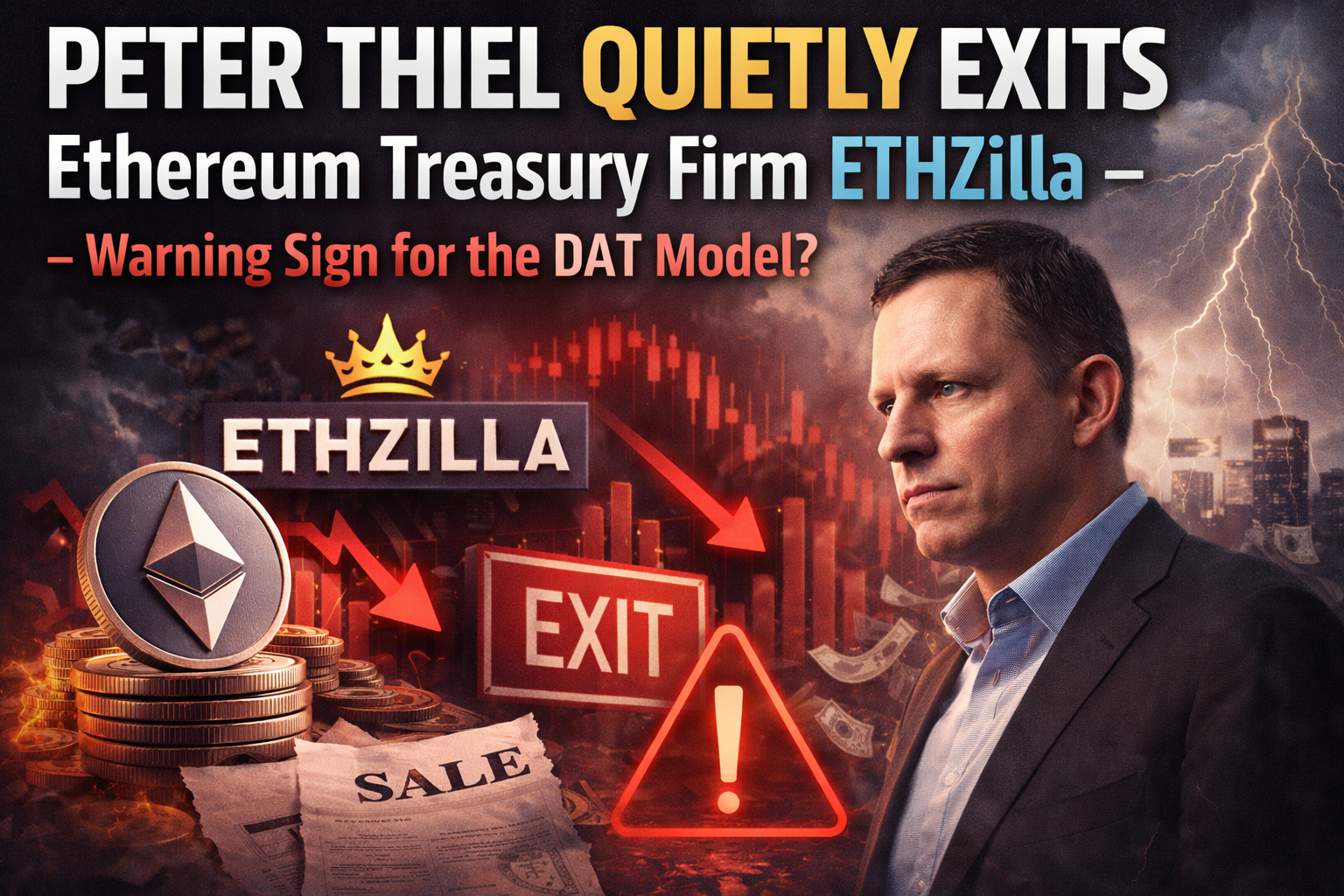
The crypto market is once again in the spotlight after a major development involving billionaire investor Peter Thiel. Reports suggest that Thiel has quietly exited Ethereum-focused treasury firm ETHZilla, raising serious questions about the future of the Digital Asset Treasury (DAT) model.
While this move may seem like a routine investment decision, many analysts believe it could signal deeper concerns about how crypto treasury companies operate especially in volatile market conditions.
What Happened?
ETHZilla, a company built around holding large amounts of Ethereum on its balance sheet, was once considered a bold experiment in crypto finance. However, its performance has declined significantly in recent months.
Thiel’s investment firm reportedly reduced its stake to zero, effectively exiting the company. This decision came after ETHZilla experienced a sharp drop in valuation, largely due to falling crypto prices and internal financial pressures.
The quiet nature of this exit has sparked speculation. In the world of investing, when “smart money” leaves without much noise, it often indicates a lack of confidence in the future outlook.
Understanding the DAT Model
The Digital Asset Treasury (DAT) model is a relatively new concept in finance. It involves companies holding cryptocurrencies such as Ethereum as core treasury assets rather than traditional cash or bonds.
The idea is simple:
- Benefit from long-term crypto price appreciation
- Earn yield through staking or decentralized finance (DeFi)
- Provide investors indirect exposure to crypto markets
ETHZilla followed this model aggressively, accumulating a large Ethereum reserve. During bullish market phases, this strategy can deliver impressive returns. However, the model becomes risky when markets turn bearish.
Why Did Peter Thiel Exit?
There are several key factors that likely influenced this decision:
1. Declining Company Value
As Ethereum’s price dropped, ETHZilla’s overall valuation also suffered. Since the company’s value is closely tied to its crypto holdings, any market downturn has a direct impact.
2. Liquidity and Debt Pressure
To manage financial obligations, ETHZilla was reportedly forced to sell portions of its ETH holdings. This not only reduced its reserves but also signaled financial stress to investors.
3. Volatility Risk
The DAT model is highly sensitive to price swings. Unlike traditional businesses, these companies often lack diversified revenue streams, making them more vulnerable during downturns.
4. Strategic Shift
ETHZilla has started exploring alternative business directions, including tokenizing real-world assets. This suggests that even the company itself may be moving away from its original treasury-focused approach.
Is This a Warning Sign for the DAT Model?
Thiel’s exit is being interpreted by many as a warning sign not just for ETHZilla, but for the entire DAT concept.
The main issue lies in overdependence on asset prices. When crypto markets rise, DAT companies perform well. But when prices fall:
- Company valuations drop sharply
- Investor confidence weakens
- Forced selling can worsen losses
This creates a cycle where declining prices lead to further selling, which then pushes prices even lower.
The situation highlights a key weakness: without diversified income sources, treasury-based companies struggle to remain stable in volatile markets.
Impact on Ethereum
It’s important to note that this development does not directly weaken Ethereum itself. The challenges are related to how companies structure their business models around crypto not the technology behind it.
Ethereum continues to lead in areas like:
- Smart contracts
- Decentralized applications (dApps)
- Blockchain innovation
However, events like this can influence institutional sentiment, making large investors more cautious in the short term.
What Happens Next?
The future of the DAT model will likely depend on how companies adapt. Possible outcomes include:
1. Evolution of the Model
Firms may diversify into staking, DeFi, or real-world asset tokenization to reduce reliance on price appreciation.
2. Market Shakeout
Weaker companies may fail or pivot, while stronger ones survive with improved strategies.
3. Increased Investor Caution
Institutional players may demand more sustainable and less risky business models.
4. Hybrid Approaches
Future treasury firms may combine crypto holdings with traditional revenue-generating activities.
FAQs
1. Who is Peter Thiel?
Peter Thiel is a well-known billionaire investor and co-founder of PayPal, famous for backing early-stage tech companies.
2. What is ETHZilla?
ETHZilla is a company that follows a crypto treasury strategy, primarily holding Ethereum as its main asset.
3. What is the DAT model?
It’s a business model where companies hold digital assets like Ethereum on their balance sheet to generate value.
4. Why is Thiel’s exit important?
Because large investors often signal market trends. His exit suggests concerns about the sustainability of ETHZilla’s strategy.
5. Is the DAT model risky?
Yes, especially during market downturns, as it depends heavily on crypto price movements.
6. Should investors be worried about Ethereum?
Not necessarily. Ethereum remains a strong blockchain, but investors should be cautious about companies built solely around holding crypto.
Conclusion
Peter Thiel’s quiet exit from ETHZilla highlights an important lesson in the crypto space: innovation alone is not enough sustainability matters. While the DAT model offered exciting possibilities during bullish periods, recent events reveal its vulnerabilities.
As the market matures, the focus will likely shift toward more balanced and resilient business models. For investors, this is a reminder to look beyond hype and evaluate the long-term viability of any strategy.