
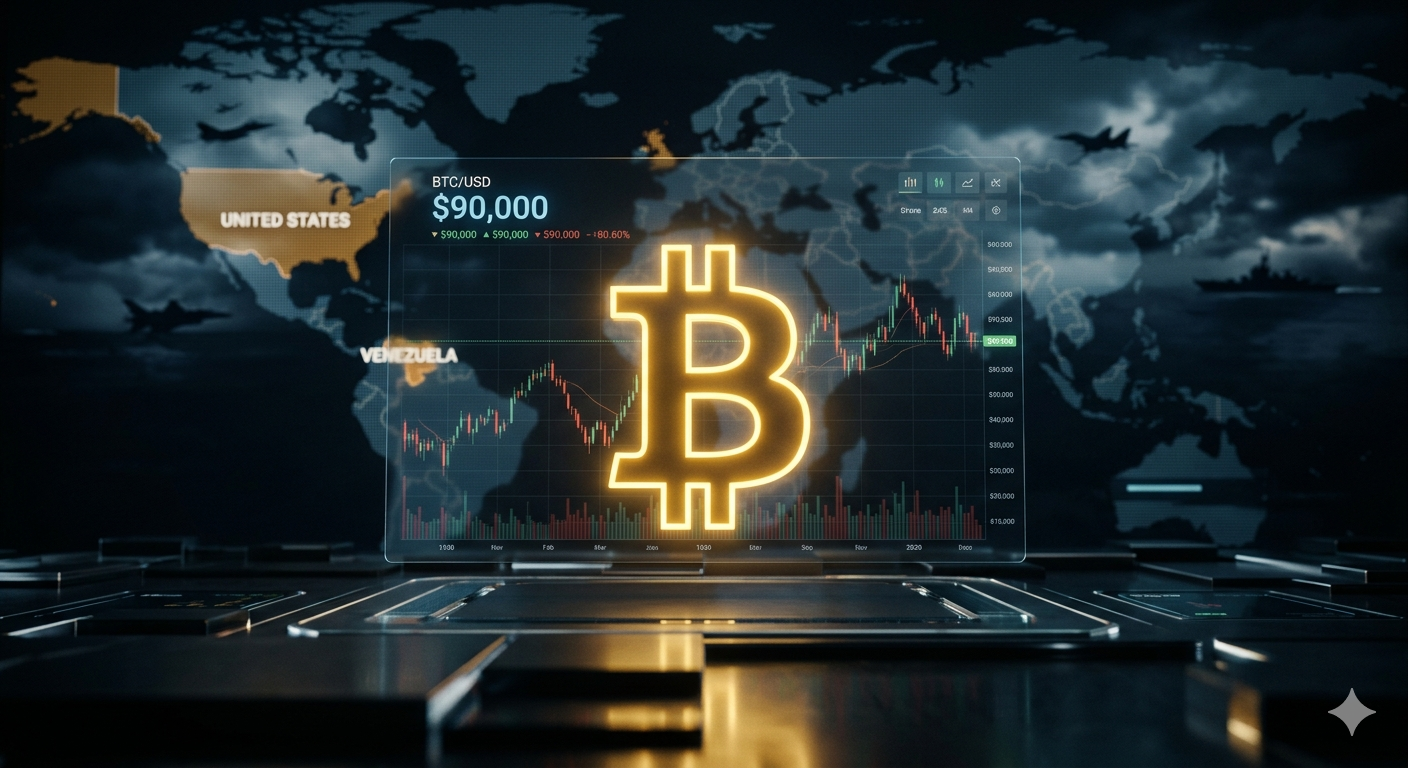
Market Stability in the Face of Global Tension
Bitcoin surprised many investors by holding steady near the $90,000 level despite a sudden escalation in geopolitical tensions between the United States and Venezuela. Following reports of military action, markets initially reacted with uncertainty, causing Bitcoin to briefly dip below $90K before quickly recovering. This muted reaction stood out, especially because traditional risk assets often experience sharp sell-offs during global conflicts.
What makes this situation more interesting is the timing. The events unfolded over the weekend when institutional traders were largely inactive, which may have limited volatility. Analysts suggest that Bitcoin’s ability to stay near this key level reflects growing market maturity. Instead of panic selling, investors appear more cautious and measured, indicating that Bitcoin is no longer reacting impulsively to every headline.
Technical Strength and Investor Confidence
From a technical perspective, Bitcoin’s price holding above its short-term support levels signals resilience. Market analysts have pointed out that staying above key indicators, such as the 21-day moving average, suggests that the asset still has bullish potential in the near term.
At the same time, broader macroeconomic factors are playing a bigger role than isolated geopolitical events. Bitcoin has increasingly become tied to global liquidity, institutional flows, and monetary policy rather than just speculation. Even after a significant correction from its previous highs above $120,000, the asset has managed to recover and stabilize around current levels, showing strong underlying demand.
Why Geopolitics Didn’t Shake Bitcoin
One key reason Bitcoin remained stable is that geopolitical events tend to influence volatility rather than long-term direction. While headlines can trigger short-term dips or spikes, lasting price movements are usually driven by deeper economic conditions such as interest rates, inflation, and global liquidity.
Another factor is the evolving perception of Bitcoin. Some investors now see it as a hedge or alternative asset that operates independently of traditional systems. While it doesn’t always behave like gold, its decentralized nature means it isn’t directly tied to any single country’s political situation. This independence may explain why it didn’t collapse despite such a major global event.
What Could Happen Next
Although Bitcoin has shown resilience, analysts warn that volatility could increase once institutional investors fully react. When traditional financial markets reopen, larger players may reassess risk and adjust their positions, potentially leading to sharper price movements.
Looking ahead, Bitcoin’s trajectory will likely depend more on macroeconomic trends than geopolitical headlines. If global liquidity improves or central banks shift toward easier monetary policies, Bitcoin could see further upside. However, if uncertainty increases, short-term fluctuations are still very possible.
FAQs
1. Why didn’t Bitcoin crash after the US–Venezuela conflict?
Bitcoin remained stable because investors are increasingly focused on long-term macro trends rather than reacting emotionally to geopolitical news.
2. Did Bitcoin drop at all during the event?
Yes, it briefly dipped below $90,000 but quickly recovered, showing strong support at that level.
3. Is Bitcoin becoming a safe-haven asset?
It is sometimes seen as an alternative asset, but it doesn’t always behave like traditional safe havens such as gold.
4. What should investors watch next?
Key factors include institutional activity, global liquidity, and central bank policies, which have a bigger impact than short-term news events.